

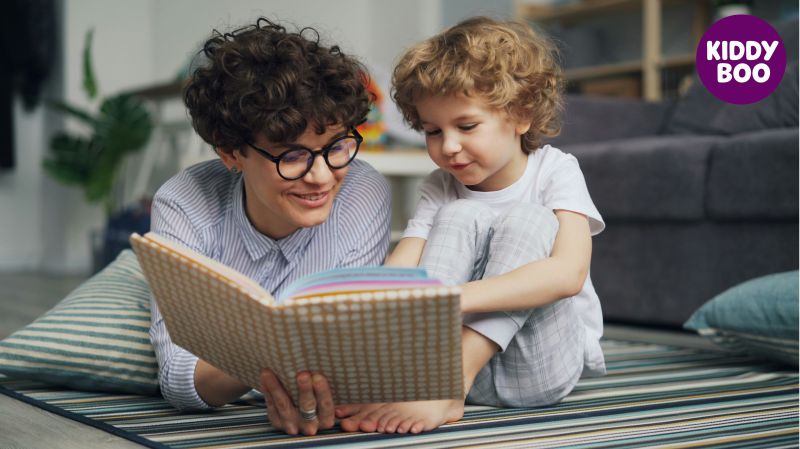
In the modern home, the early childhood learning environment has changed dramatically. Parents are more conscious than ever of the role technology plays in their children’s development, yet they’re also under growing pressure to meet the needs of increasingly curious, fast-learning young minds. This tension between nurturing a child’s curiosity and protecting their developmental health is precisely what inspired Grigory and Natalia Lyubarskiy to launch KiddyBoo Books, an educational technology startup that blends printed children’s books with AI-powered interactivity.
As parents of two sons, the Lyubarskiys experienced first-hand the challenge of answering a constant stream of questions from their preschooler, often in the middle of busy workdays, meal preparation, or family routines. At the same time, they saw how easily digital devices could occupy a child’s attention but felt uneasy about relying on screens to fulfill such a crucial part of a child’s development.
“We wanted something that supports curiosity but respects how kids actually learn,” says Grigory Lyubarskiy. “Books are great for that: they’re tangible, open-ended, and calm. But kids also need feedback. That’s where the assistant comes in.”
KiddyBoo emerged as a hybrid solution: physical books that retain the tactile and imaginative benefits of traditional reading, enhanced by a voice-based AI assistant that responds to children’s questions in real time. The assistant is accessed through a phone placed nearby and interacts with the child naturally, guiding them through questions, reinforcing learning, and adapting to their age and language. All without requiring the child to stare at a screen.
What makes KiddyBoo Books especially relevant today is its positioning between two extremes in the early education market. On one end are classic children’s books, which are rich in storytelling and sensory experience but limited in interactivity. On the other end are mobile apps and digital games, which offer engagement and scalability but often at the expense of passive screen time and overstimulation. KiddyBoo doesn’t reject either world — it connects them. The result is an experience that supports independent learning, sustains attention, and encourages conversation, without replacing the role of parents or reducing learning to swipes and taps.
A Carefully Designed Ecosystem for Families, Not Just Kids
Bringing this idea to life required balancing the expectations of two very different audiences: the children who would use the product, and the adults who would decide to bring it into the home. On one hand, the books needed to hold a child’s attention, spark curiosity, and invite natural interaction. On the other hand, they needed to reflect the values and priorities of parents: educational integrity, cognitive development, and responsible technology use.
From the beginning, the Lyubarskiys focused on creating a seamless, low-friction experience for both. The physical books are beautifully illustrated and age-appropriate. Embedded within each copy is a QR code that connects to a voice assistant. Once set up by a parent, the assistant activates via voice, responding in the child’s preferred language, adjusting complexity, and even offering clues rather than direct answers to promote critical thinking. Notably, the child continues to interact with the physical book throughout, not a screen, preserving the tactile, real-world experience.
“We didn’t want to create another app. Kids already get too much screen time. We wanted to keep the physical, hands-on experience: turning pages, pointing to pictures, asking out loud, but make it more dynamic.”
One of the startup’s most notable design choices was multilingual support from the start. The voice assistant will launch with English and French and expand to include Mandarin and Hindi — a decision that reflects both Canada’s multicultural makeup and the reality that many children grow up in bilingual households.
The company is also introducing KiddyBoo Galaxy, an optional online component that allows children to share completed activities and view creations by others. But even here, the platform is designed to limit passive consumption. It’s a complement, not a replacement, to the physical reading experience.
Strategic Growth with a Focus on Local Expertise
KiddyBoo Books is currently in its final prototyping phase, with early feedback from pilot users, including parents, preschool educators, and child development specialists, overwhelmingly positive. Interest has already been expressed by Canadian toy retailers, bookstores, and early learning institutions. The company is preparing for an official launch in 2025, beginning with the Canadian market through both Amazon and a dedicated e-commerce platform.
From there, the growth strategy is deliberately measured. The team plans to expand KiddyBoo’s retail presence across Canada before entering the U.S. market in 2028. Localization efforts are already underway, including partnerships with North American children’s book illustrators, education consultants, and developers specializing in child-safe AI. The company has made it a priority to build with local expertise, ensuring that cultural nuance, educational standards, and parent expectations are fully integrated into the product.
Hiring is focused on talent that understands not only the technical side of AI integration but also the creative and emotional dimensions of early childhood education, areas where simple functionality is not enough. As the platform evolves, there are plans to introduce additional content series, expand language support, and develop features aimed at neurodiverse learners and children with different developmental needs.
What sets KiddyBoo Books apart is not just its technology, but its philosophy. It treats learning as a relational experience — not something that should be outsourced to a device, but something that can be extended and enriched through thoughtful innovation. The Lyubarskiys aren’t aiming to disrupt parenting or replace traditional storytelling. They’re building a tool that respects both, while adding something new.
In a time when educational products are often optimized for engagement metrics, KiddyBoo stands out for optimizing for something more challenging to measure: sustained curiosity, self-guided discovery, and a learning experience that keeps both feet in the real world.
